


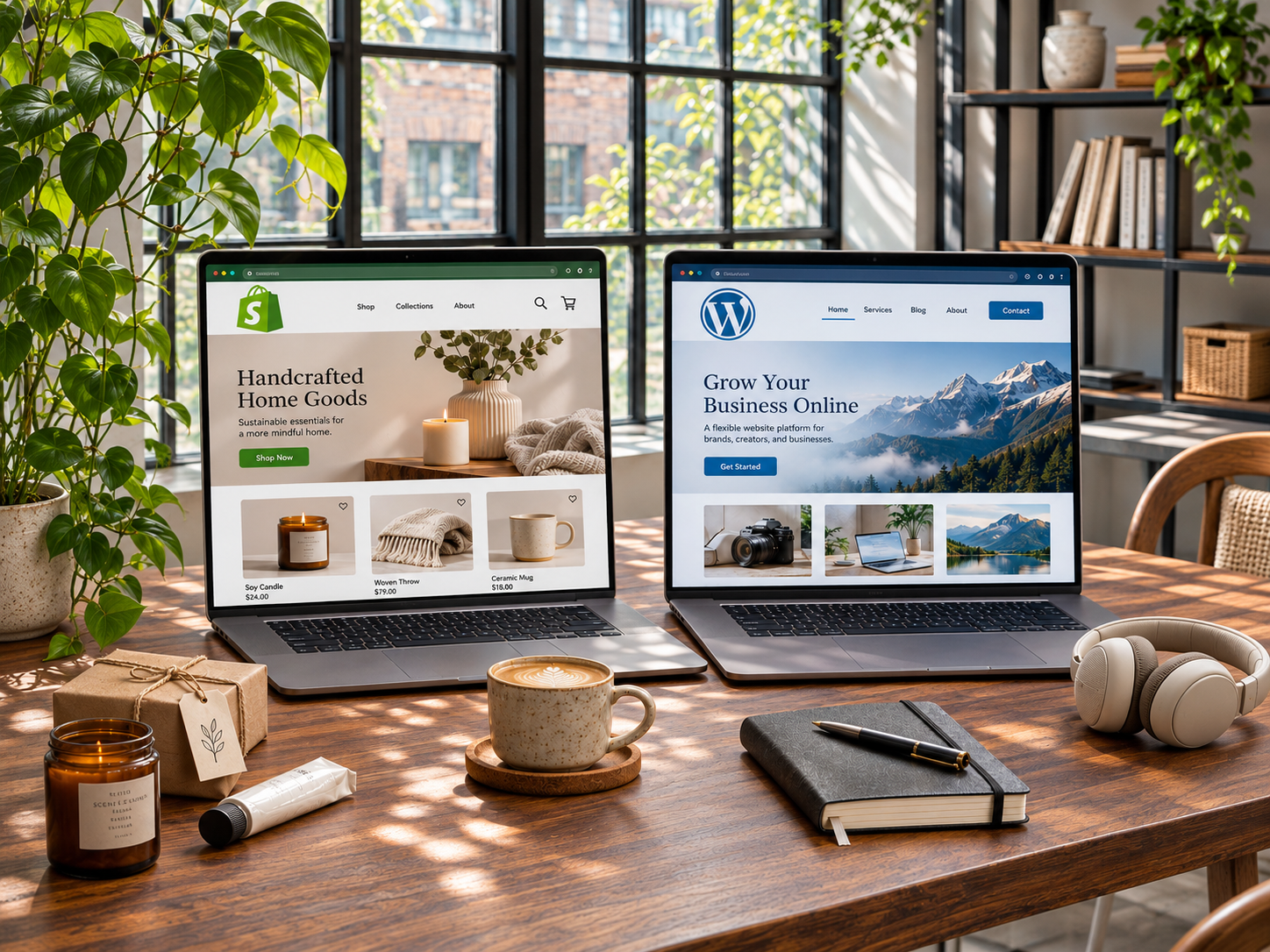
Your business needs a proper website. Maybe you sell clothes through Instagram and want a real online store, or you run a service business and want customers to find you on Google. Then one person tells you to use Shopify, and another swears by WordPress. The Shopify vs WordPress debate has no single winner, because the right choice depends on what you sell and how you plan to grow.
This guide compares both platforms on cost, ease of use, payments, SEO and long-term control, so you can pick the one that fits your business instead of the one a friend happens to use.
The Quick Answer
Choose Shopify if you mainly sell products online and want a store that works quickly without technical upkeep. Choose WordPress if you run a service business, plan to publish a lot of content, or want full ownership of your site. Need an online store on WordPress? You add WooCommerce, a free plugin that turns a WordPress site into a complete ecommerce store.
What Is Shopify?
Shopify is a hosted ecommerce platform. Shopify charges a fixed monthly amount and in return runs the servers, keeps the platform secure, rolls out updates and handles every checkout. You pick a theme, add your products, connect a payment method and start selling.
Everything a store owner needs lives in one dashboard: inventory, orders, discounts and shipping. The tradeoff is control. You work inside Shopify’s rules, and many extra features come through apps that add to your monthly bill.
What Is WordPress?
WordPress is free, open-source software for building websites. You pay for hosting and a domain, and usually for a premium theme and a few plugins. Out of the box, it handles business websites and blogs. Once WooCommerce is plugged in, your WordPress site starts working as a proper shop.
You own the whole site. You can move it to another host, change any part of the design and add almost any feature. All that control means the maintenance is yours, whether you handle it yourself or pay a developer.
Shopify vs WordPress WooCommerce at a Glance
| Factor | Shopify | WordPress + WooCommerce |
|---|---|---|
| Best for | Product stores that want to launch fast | Service businesses, content-heavy sites and flexible stores |
| Setup | Quick, guided setup | Needs hosting, installation and configuration |
| Monthly cost | Fixed plan fee plus apps | Hosting plus optional paid plugins |
| Maintenance | Shopify handles it | You or your developer handle it |
| Design freedom | Good, within theme limits | Almost unlimited |
| Blogging | Basic | Excellent |
| SEO control | Solid basics, some fixed settings | Full control |
| Ownership | Your store runs on Shopify’s platform | You own the site and files |
Which Platform Is Easier to Use?
Shopify wins for beginners. Its setup walks you through each step, and you never have to think about servers or software updates. A shop owner with no technical background can have a working store within a few days.
WordPress asks for more at the start. You choose hosting, install the software, pick a theme and set up plugins. Page builders make the editing side much friendlier, and once the site is live, adding pages or blog posts feels simple. Most business owners hire someone for the initial build and then manage day-to-day content themselves.
Shopify vs WordPress Cost Breakdown
Shopify’s Basic plan costs around $39 a month on monthly billing, and less if you pay yearly. On top of that, expect to pay for a premium theme if you want one, plus monthly fees for apps such as reviews, upsells or advanced shipping rules. Shopify also charges an extra transaction fee when you use a third-party payment gateway instead of Shopify Payments, which is 2% on the Basic plan.
WordPress itself costs nothing. Your regular costs are hosting and a yearly domain renewal, with premium themes and plugins as optional extras. Developer time is the biggest variable. A simple business site costs far less than a custom online store with hundreds of products.
Over a few years, WordPress usually costs less for small and mid-sized sites. Shopify often feels cheaper in the first month, then grows as you add apps.
Shopify vs WordPress Cost in Pakistan
Shopify bills in US dollars, so your monthly cost moves with the rupee exchange rate. WordPress hosting is widely available from local providers who charge in PKR, which keeps the running cost predictable. Pakistani Shopify stores also pay that extra transaction fee, because Shopify Payments isn’t offered in Pakistan. Add it to your budget before you compare the two.
Payment Gateways and Cash on Delivery in Pakistan
Payments matter more than most owners expect. Since Shopify Payments isn’t available in Pakistan, Shopify stores connect a local gateway instead. PayFast and XPay both work with Shopify, and PayFast also works with WooCommerce, so card and wallet payments are possible on either platform.
Cash on delivery still drives a large share of online orders in Pakistan, and both platforms support it. Shopify lets you add COD as a manual payment method, and WooCommerce includes it by default. Courier booking and tracking come through apps on Shopify and plugins on WordPress, so check that your preferred courier connects before you commit.
Which One Is Better for SEO?
Both platforms can rank well. WordPress gives you more control. You can shape URLs, edit every meta tag, add schema markup and use plugins like Yoast or Rank Math to guide your on-page work. Its blogging tools are also among the best available, which helps if content will drive your traffic.
Shopify covers the basics well, including editable titles, meta descriptions and automatic sitemaps. Some settings are fixed, though. Product and collection URLs follow a set pattern, and the built-in blog is fairly simple. For most product stores this works fine, but content-led businesses often outgrow it.
The platform only gives you a starting point. Rankings come from keyword research, strong pages and steady content after launch, and that is where dedicated SEO services make the real difference on either platform.
Which One Should You Choose?
When people compare WordPress vs Shopify for ecommerce, the answer usually comes down to three things: what you sell, how much control you want and who will run the site after launch.
Shopify Is the Better Fit If
- You sell physical products and want to launch quickly.
- You already sell on Instagram or a marketplace and want your own branded store.
- You don’t want to deal with hosting, updates or security.
A well-built store makes a big difference to sales from the first day. Professional Shopify Store Development Services set up your theme, payments, shipping rules and product pages properly, so you start selling instead of fixing problems.
WordPress Is the Better Fit If
- You run a service business such as a clinic, school, agency or contractor.
- You plan to publish blogs and guides to bring in traffic.
- You want full ownership and lower running costs over time.
- You need a store with a large catalogue on a tighter monthly budget.
WordPress shines when the site fits your business exactly. With Custom Website Development, you get a design and feature set built around your services, not a template that almost fits.
Common Mistakes When Picking a Platform
Choosing on price alone. The cheapest setup today can cost more later if you have to rebuild the site once your business grows.
Forgetting who will maintain it. A WordPress site with nobody handling updates becomes a security risk. A Shopify store packed with unused apps quietly drains money every month.
Ignoring payment options. Confirm that your gateway, cash on delivery setup and courier all work with the platform before you build anything.
Copying a competitor’s choice. Their platform suits their business model, which may look nothing like yours.
Frequently Asked Questions
Is Shopify Available in Pakistan?
Yes. You can build and run a Shopify store from Pakistan. Shopify Payments isn’t available there, so you accept payments through local gateways like PayFast or XPay, plus cash on delivery.
Is WordPress Cheaper Than Shopify?
Usually, over the long run. WordPress has no platform fee, but a custom build or paid plugins can raise the upfront cost.
Can I Move From Shopify to WordPress Later?
Yes. You can export products, customers and orders. The design needs rebuilding, and you should redirect old URLs to protect your rankings.
Which Is Better for a Small Online Store?
Shopify is simpler for most small stores. WooCommerce suits owners who want more control and are comfortable managing a WordPress site.
Pick the Platform That Fits Your Growth Plans
Shopify gives product sellers speed and simplicity. WordPress gives service businesses and content-driven brands flexibility and ownership. Think about what you sell, who will manage the site and where you want the business to be in three years, and the right choice usually becomes clear.
Whichever way you go, your website should bring in customers, not just look good. SEO Blink helps businesses plan, build and grow sites that rank, and our website development team can help you choose the right platform before you spend a rupee on the build.